
Semiconductor Fuses: aR Class Protection for Diodes, Thyristors, and IGBTs
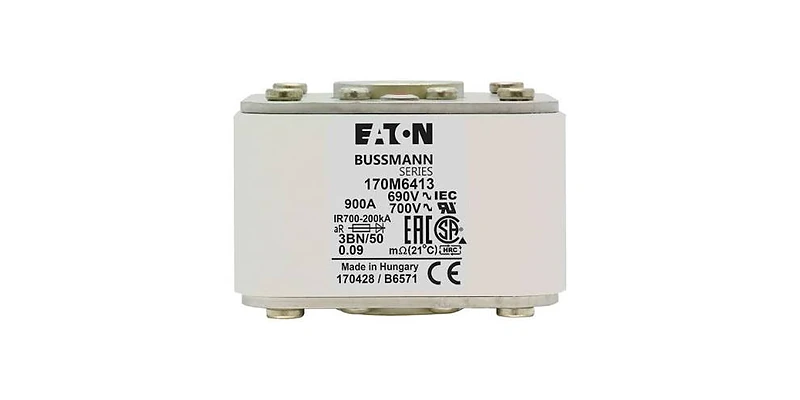
Semiconductor Fuses: aR Class Protection for Diodes, Thyristors, and IGBTs
Power semiconductors — diodes, thyristors (SCRs), and IGBTs — have very low thermal mass compared to cables, motors, or transformers. A short-circuit current that a cable can withstand for 100 milliseconds will destroy a semiconductor device in less than 1 millisecond. Standard industrial fuses are far too slow for semiconductor protection.
Semiconductor fuses — classified as aR under IEC 60269-4 (also called “high-speed fuses” or “rectifier fuses”) — are designed specifically for this application. They have very low I2t values, very fast opening times, and verified DC interrupting ratings for use in rectifier and inverter circuits.
This article explains how aR fuses work, where they are used, and how to coordinate them with the I2t withstand of specific semiconductor devices.
What “aR” Means
Under IEC 60269-4, fuse classes are designated by two letters:
- First letter (a, g):
- a = partial range (the fuse does not need to clear low overcurrents; relies on upstream protection for low-overload conditions)
- g = full range (the fuse clears all overcurrents from minimum melting current to interrupting rating)
- Second letter (R, M, etc.):
- R = semiconductor protection (rectifier circuits)
- M = motor protection
- B = mining
- Tr = transformer
So aR = “partial range, semiconductor protection.” The “partial range” designation means the fuse is intended to clear short circuits and high overcurrents, but not small overloads — typically, a coordinated upstream device (circuit breaker or larger fuse) handles the overload range.
This matches semiconductor behavior: a semiconductor device that experiences a sustained overload will fail from overheating, not from the overcurrent itself, so the fuse does not need to clear low overloads. The fuse only needs to react quickly to short circuits and severe overcurrents.
Why Semiconductors Need Special Fuses
A silicon diode or thyristor has a junction thermal capacity measured in millijoules. A 1000 A IGBT module might withstand I2t of 100,000 A2s for 10 ms — but only 10,000 A2s for 1 ms, and 1,000 A2s for 100 µs. The fuse must open before the semiconductor’s thermal limit is exceeded.
Standard industrial fuses (Class J, Class RK1) have I2t values 10-100× higher than semiconductor fuses at the same amperage. They cannot protect semiconductors from short-circuit damage — they are simply too slow.
Semiconductor fuses use:
- Pure silver elements (not copper or tin alloys) for low melting temperature and predictable behavior
- High-purity quartz sand filler for fast arc extinction
- Constricted element shapes that force the arc into multiple narrow paths, increasing arc voltage and accelerating current zero
- Short internal connections to minimize parasitic inductance
These design choices produce fuses with very low I2t and very fast opening (sub-millisecond for high currents).
Common aR Fuse Series
Bussmann manufactures several semiconductor fuse families:
Each series has slightly different voltage, current, and AIC ratings to match specific applications.
aR Fuse Applications
Variable Frequency Drives (VFDs)
A VFD has three protection points:
- Input (rectifier side): aR fuse between the AC line and the rectifier bridge. Protects the rectifier diodes from short-circuit damage if the DC bus shorts.
- DC bus: aR fuse between the DC bus capacitors and the IGBT inverter. Protects the IGBTs and the capacitors from each other in case of failure.
- Output (motor side): Often no fuse, because the cable and motor have higher I2t withstand than the IGBTs. Output fuses are sometimes added for short-circuit protection when long motor cables are used.
For a 100 hp (75 kW) VFD at 480 V three-phase:
- Input current: 125 A
- Input fuse: 200 A FWH series (500 V AC, 200 kA AIC)
- DC bus voltage: 700 V DC
- DC bus fuse: 250 A FWP series (700 V DC, 100 kA AIC)
Solar PV Combiners and Inverters
PV systems use aR fuses in two locations:
- String combiner: Each PV string has a fuse that isolates the string if it fails as a short. Typical: 15-30 A, 1000 V DC, FWP series.
- Inverter DC input: A fuse on the DC bus before the inverter’s input stage. Typical: 100-400 A, 1000 V DC, FWP or FWJ series.
The DC voltage (up to 1500 V for modern 1500 V PV systems) requires fuses with verified 1500 V DC ratings. Only specific fuse series (e.g., Bussmann FWP 1500 V) have these ratings.
Battery Energy Storage Systems (BESS)
Lithium-ion battery strings operate at 400-1500 V DC and can deliver massive fault currents. Each battery rack or string requires:
- DC-rated aR fuse at the battery output
- AIC greater than the maximum battery short-circuit current (typically 20-50 kA for large strings)
- Fast opening to prevent thermal runaway
For a 1 MWh BESS at 1000 V DC:
- Continuous current: 1000 A
- Fuse size: 1200-1400 A FWJ series (1000 V DC, 100 kA AIC)
Uninterruptible Power Supplies (UPS)
UPS systems use aR fuses for:
- Battery fuse: Protects the UPS from battery short-circuit. Critical for safety.
- Inverter input fuse: Protects the IGBT inverter stage from DC bus faults.
EV Fast Charging
DC fast chargers (covered in detail in our EV charging article) use aR fuses on the DC bus and output, typically FWJ series at 1000 V DC.
Induction Heating and Welding
Industrial induction heaters and welders use thyristors (SCRs) at high currents. aR fuses protect the SCRs from short circuits in the heating coil or welding transformer.
Coordinating Semiconductor Fuses with Device I2t
The coordination rule is identical to industrial fuses but with tighter margins:
Semiconductor device I2t withstand ≥ Semiconductor fuse total clearing I2t × 0.8
The 0.8 multiplier (not 1.0) accounts for:
- Device I2t rating may be conservative
- Actual fault current may differ from calculated
- Fuse I2t varies with current and voltage
Most semiconductor datasheets include coordination curves that show the safe operating region for specific fuse-device pairs. Use these curves rather than manual I2t calculations when available.
aR Fuse Body Styles
Semiconductor fuses come in several physical configurations:
- Ferrule (round body): 10×38 mm, 14×51 mm, 22×58 mm — for currents up to approximately 100 A
- Blade (rectangular body with blade terminals): 30-2000 A — common for FWH and FWJ
- Square body (bolted tags): 200-7500 A — for large drives and battery systems
- Flush-end (cylindrical with end caps): 50-1600 A — for compact high-current applications
The fuse holder or mounting must match the body style. Many semiconductor fuses use bolted connections rather than clips for better electrical and thermal performance at high currents.
Microseconds vs. Milliseconds: Why Speed Matters
A standard Class J fuse might open in 5-10 milliseconds at 10× rated current. A semiconductor fuse opens in 0.5-2 milliseconds at the same multiple. This 10× speed difference is the difference between a protected semiconductor and a destroyed one.
For a 1000 A short circuit through a 200 A fuse:
- Class J fuse: Opens in 5 ms → I2t ≈ 10002 × 0.005 = 5,000,000 A2s
- aR fuse: Opens in 0.5 ms → I2t ≈ 10002 × 0.0005 = 500,000 A2s
The aR fuse delivers 1/10 the energy — well within the semiconductor’s withstand.
Striker Indicators
Many semiconductor fuses (especially the 170M and 170H series) include a striker — a small pin that extends from the fuse body when the element melts. The striker can be wired to:
- A visual indicator (LED on a panel)
- An alarm circuit (sounds a horn or sends a notification)
- A trip circuit (drops the upstream breaker)
Strikers allow remote identification of a blown fuse without opening the cabinet, reducing arc-flash risk and speeding troubleshooting.
Frequently Asked Questions
Can I use a Class J fuse instead of a semiconductor fuse? Only if the downstream device’s I2t withstand is high enough to survive the Class J’s slower opening. For diodes, thyristors, and IGBTs, this is almost never the case.
Why are semiconductor fuses so expensive? The silver element, quartz filler, precision construction, and verification testing all cost more than standard industrial fuses. The premium is justified by the value of the protected equipment.
Do I need a fuse on the AC input of a VFD if it has internal fuses? The VFD’s internal fuses are typically sized for the rectifier’s I2t only. An external upstream fuse (smaller) provides better coordination with the upstream transformer and limits the energy through the rectifier during a major fault.
What is the difference between aR and gR fuses? aR is partial range (short-circuit only). gR is full range (overload + short-circuit). gR fuses are used when no upstream protection handles the overload range; aR fuses are used when upstream protection exists.
Where to Buy Semiconductor Fuses
FuseStock stocks the complete Bussmann semiconductor fuse line — FWH, FWJ, FWP, 170M, 170H — for VFD, UPS, PV, EV charging, and battery storage applications. All fuses ship with full I2t, AIC, and time-current curve data.
For semiconductor coordination support, submit your drive or inverter part number and we will match the appropriate aR fuse and verify I2t coordination with the device’s published withstand.