
Marine and Offshore Fuse Requirements: Approval, Environment, and Selection
Marine and Offshore Fuse Requirements: Approval, Environment, and Selection
Electrical installations on ships, offshore platforms, and marine terminals face salt, vibration, temperature swings, humidity, and limited maintenance access. Acceptance is project-specific: the fuse, holder, enclosure, and installation may need to comply with flag-state rules, the vessel’s classification society, and the approved equipment schedule. Do not assume that a standard industrial catalog number is marine-approved without checking a current certificate and its scope.
This guide covers the marine certification landscape, the specific fuse requirements for shipboard and offshore use, and how to select fuses that meet both regulatory and operational demands.
Why Standard Industrial Fuses Fail at Sea
An industrial fuse installation that is reliable in a dry plant may age differently at sea unless the complete assembly is selected and protected for the environment:
Salt corrosion: Sodium chloride deposits on metal surfaces accelerate oxidation and increase contact resistance. Higher resistance causes local heating, which accelerates corrosion further. Over time, this can create overheating and nuisance operation; service life depends on enclosure, materials, loading, and maintenance.
Vibration: Marine environments experience continuous vibration from engines, propellers, and wave action. Standard fuse clips can work loose over time, leading to intermittent contact, heating, and accelerated aging. Locking clips or bolted connections are required for high-vibration zones.
Temperature: Engine rooms reach 50-60 °C ambient; exterior deck equipment sees -20 °C to +50 °C. Standard fuses may need derating at high ambient temperatures.
Humidity: Condensation can form inside fuse holders, leading to corrosion and tracking. Marine fuses often have conformal coating or sealed bodies.
Shock and impact: Heavy seas can cause mechanical shock that damages fuse elements. Marine fuses are shock-tested per IACS UR E10 or similar standards.
Maintenance access: At sea, finding a replacement fuse may be impossible for days. Fuses must have longer service life and better reliability than land-based equivalents.
Classification Society Requirements
The major marine classification societies each have specific requirements for electrical equipment, including fuses:
ABS (American Bureau of Shipping)
ABS publishes the ABS Rules for Building and Classing Steel Vessels and Rules for Building and Classing Mobile Offshore Units. Part 4, Chapter 6 covers electrical installations.
ABS requires that fuses on vessels:
- Meet UL 248 or IEC 60269 standards
- Have verified interrupting rating at the system voltage
- Be installed in enclosures rated for the installation environment (IP rating per IEC 60529)
- Be accessible for replacement without removing other equipment
- Be marked with rating, voltage, and interrupting rating
ABS publishes a list of approved manufacturers and products. The Bussmann marine fuse series (e.g., the FNQ-R, KTK-R, and LPJ-SPI with marine certifications) appear on the ABS approved list.
Lloyd’s Register (LR)
Lloyd’s Register Type Approval System covers electrical equipment for ships. Fuses with LR Type Approval have been tested per LR’s environmental and performance specifications, including:
- Vibration testing per LR TA1
- Temperature testing per LR TA1
- Salt fog testing per IEC 60068-2-52
- Damp heat testing per IEC 60068-2-78
LR-approved fuses bear the LR Type Approval mark and are listed in the LR Marine Equipment Register.
DNV
DNV publishes rules and type-approval programs for ships and offshore units. Certificate scope and validity must be checked in the current approval database.
- Performance per IEC 60269
- Environmental testing per DNVGL-CG-0339
- EMC compatibility
- Quality assurance per ISO 9001
DNV approval may be specified for projects classed by DNV; other projects may require ABS, LR, BV, RINA, ClassNK, KR, CCS, or another recognized society.
Other Class Societies
Other recognized class societies include:
- Bureau Veritas (BV) — French classification, common for European vessels
- Registro Italiano Navale (RINA) — Italian classification
- ClassNK — Japanese classification
- Korean Register (KR) — Korean classification
- China Classification Society (CCS) — Chinese classification
Each society has its own rules and certificate scope. Approval by one society should not be assumed equivalent unless the project specification or approving authority accepts it.
Specific Fuse Types for Marine Use
Shipboard Service (230/400 V or 440/690 V)
For shipboard distribution, the same fuse classes used on land (Class J, Class RK1, Class CF) apply, but with marine certification:
- Bussmann LPJ-SPI with ABS / LR / DNV approval for branch circuit protection
- Bussmann TCF (CUBEFuse) with marine approval for compact installations
- Bussmann FWH / FWJ for semiconductor protection in VFDs and motor drives
Battery Banks (DC, often 24 V / 110 V / 220 V)
Shipboard battery banks for emergency power, navigation, and communication require DC-rated fuses. Standard AC fuses may not interrupt DC fault currents reliably.
- Bussmann 170M series with DC rating for large battery installations
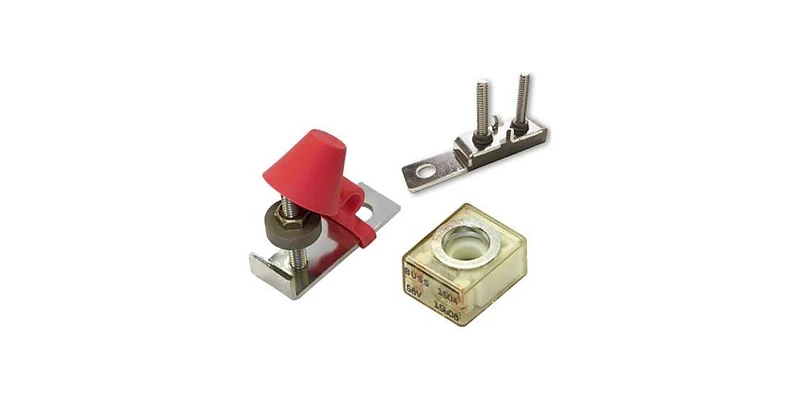
- MRBF (Marine Rated Battery Fuse) — a specific fuse style for battery circuits, rated for DC
Deck and Exterior Equipment
Equipment exposed to weather (deck lights, winch motors, anchor windlasses) requires:
- IP56 or IP66 rated fuse holders for weather resistance
- Stainless steel or hot-dip galvanized enclosures for corrosion resistance
- Tin-plated or silver-plated fuse clips to prevent oxidation
Engine Room
Engine room fuses face high ambient temperature (up to 55 °C) and vibration. Specify:
- High-temperature-rated fuses (typically 70 °C or higher)
- Locking-type fuse holders to prevent vibration loosening
- Shock-tested fuses per IACS UR E10
Voltage and Frequency Considerations
Shipboard electrical systems often operate at frequencies different from 50/60 Hz land power:
- 440 V at 60 Hz — common for merchant vessels built in US/Japan
- 400 V at 50 Hz — common for European vessels
- 690 V at 60 Hz — common for large motor drives
Fuses rated for 50/60 Hz typically work at any frequency between 45-65 Hz without derating. For very high frequencies (400 Hz, used in aviation and some military vessels), special fuses are required.
Ambient Temperature Derating
Most fuses are calibrated at 25 °C ambient. At higher ambient temperatures, the fuse runs hotter and may trip at lower currents. Derating rules:
- 50 °C ambient: Derate by approximately 5-10%
- 60 °C ambient: Derate by approximately 10-15%
- 70 °C ambient: Derate by approximately 15-20%
For engine room installations at 55 °C ambient, specify a fuse with at least 110% of the calculated continuous current.
Vibration and Shock Testing
Marine fuses must pass:
- IACS UR E10: Vibration testing at 0.7 g acceleration across 5-100 Hz
- IEC 60068-2-6: Sinusoidal vibration
- IEC 60068-2-27: Mechanical shock (15 g / 11 ms half-sine)
Standard industrial fuses may not meet these requirements. Marine-approved fuses have additional mechanical reinforcement (locked elements, welded connections, sealed bodies).
Corrosion Protection
Marine fuses typically have:
- Stainless steel end caps (rather than nickel-plated brass)
- Tin or silver plating on terminals
- Epoxy or ceramic body coating for moisture barrier
- Hermetically sealed elements (in some high-reliability fuses)
The Bussmann marine fuse line uses 316L stainless steel for end caps and terminals, suitable for saltwater exposure.
Practical Selection Example
A 5000 TEU container ship with 440 V at 60 Hz shipboard service:
All fuses in the above table must be checked against the project’s required class approval and a current certificate covering the exact catalog number.
Offshore Platform Considerations
Offshore platforms (oil and gas, wind farms) add additional requirements:
- Hazardous area classification: Some areas are classified as Zone 1 or Zone 2 (IEC 60079) requiring explosion-proof (Ex d) or increased safety (Ex e) equipment. Fuse enclosures must meet the zone classification.
- H2S exposure: Sour service (H2S-containing) environments attack copper and silver. Specify H2S-resistant fuses with special coatings.
- Subsea systems: Subsea umbilical cables and equipment operate at very high pressures. Specialized pressure-tolerant fuses are required.
For offshore wind farms, the nacelle (housing the generator and gearbox) uses marine-class fuses in vibration-isolated enclosures. The tower base uses standard industrial fuses but with marine certification.
Frequently Asked Questions
Can I use a regular LPJ fuse on a ship? Electrical suitability alone does not establish class acceptance. Verify the exact fuse, holder, enclosure, and certificate scope with the approving authority.
What is the most important marine certification? It depends on the vessel’s class, flag-state requirements, owner specification, and equipment schedule. Do not infer the required approval from geography alone.
Do marine fuses cost more than standard industrial fuses? Typically 10-30% more, due to certification, testing, and corrosion-resistant materials.
How long do marine fuses last? Properly specified marine fuses can last 15-20 years in service. Standard industrial fuses in marine environments typically fail in 3-5 years.
Where to Source Marine-Approved Fuses
Submit the vessel class, system voltage, available fault current, ambient conditions, and required certificate with your inquiry. FuseStock can then check current product availability and documentation for the exact catalog numbers requested.