



NH Fuse and Neutral Link Guide: IEC 60269-2 Sizes, gG/aM, Bases and Solid Links

The NH fuse system is one of the standard industrial fuse architectures defined in IEC 60269-2. It uses square-bodied fuse links with blade contacts, installed in matching NH bases, fuse rails or switch-disconnectors. Current Eaton and Mersen ranges cover sizes from the compact NH000/NH00 end through NH4 and beyond, with gG, aM and application-specific variants for industrial distribution.
The most important correction to many simplified NH guides is the standard number: NH is an IEC 60269-2 fuse system, not IEC 60269-4. IEC 60269-4 covers semiconductor fuse links. The 2024/2025 consolidated IEC 60269-2 specifically identifies fuse systems A through D as NH arrangements: blade-contact fuse links, striker fuse links, fuse rails and busbar-mounted bases.
NH is also more standardized than some descriptions suggest. The point of the IEC/DIN dimensional system is that size and interface are defined. That does not mean every fuse can be installed in every base: voltage, current, admissible power dissipation, utilization category and mounting all still matter. But it is too strong to say that an NH link is “valid only in the exact base it was type-tested with” or that cross-manufacturer use automatically voids the system. Application compatibility is the real engineering check.
NH size is a physical frame, not an ampere rating
NH000, NH00, NH0, NH1, NH2, NH3 and NH4 are construction sizes. They describe the physical envelope and contact system, not the fuse’s ampere rating.

Current Eaton products show how much overlap exists. A 100 A gG fuse is available in NH000, NH00 and NH1 constructions in different product families. NH00 gG products can reach 160 A in current Eaton 500 V ranges, while NH2 products extend into several hundred amperes and NH4 covers much higher currents.
The base has its own continuous-current limit. Eaton’s current NH base data lists, for example, NH00 bases at 160 A, NH1 at 250 A, NH2 at 400 A and NH3 at 630 A, with NH4 base variants reaching higher values. Those are base ratings, not proof that every fuse link of that size is suitable at the maximum base current.
This distinction is important in replacement work. “NH2” identifies the body size. The actual fuse might be 160 A aM, 250 A gG, 300 A gG, 425 A gG or another rating supported by that product family. The ampere value printed on the fuse is still the operating rating.
gG and aM: utilization category, not speed alphabet
Another major correction is the IEC letter system. The first letter is not a scale running from a through g to indicate progressively slower fuses.

In IEC fuse utilization categories:
- g means full-range breaking capacity.
- a means partial-range breaking capacity.
- The second letter identifies the application or characteristic.
Therefore gG is full-range protection for general applications. It can protect against overload and short circuit when correctly selected, which is why it is widely used for cables, feeders and general distribution.
aM is partial-range motor protection. It is intended primarily for short-circuit protection and must be coordinated with a separate overload-protection function. Its operating curve is suited to motor starting, but it is not a general-purpose full-range replacement for gG.
Eaton’s current application guide states this explicitly: gG is full-range, general application; gM is full-range motor application; aM is partial-range motor application. Mersen likewise describes gG NH links as full-range devices capable of interrupting currents from their lowest fusing region through their rated breaking capacity.
This is the language that should be used in a modern NH article. Describing a, b, c, d, e, f, g as a time-delay ladder is not the IEC 60269 utilization-category system.
Voltage, breaking capacity and base limits
NH is available across multiple AC voltage classes. Current Eaton examples include 500 V, 690 V and even specialized 800 V gG products.
Breaking capacity is product-specific, but current standard Eaton NH gG products are stronger than a generic “about 100 kA at lower voltage and lower at 690 V” description suggests. Eaton publishes 120 kA breaking capacity on current 500 V and 690 V gG families including NH00, NH1, NH2 and NH4 products. A specialized 800 V NH00 product is published at 80 kA.
The correct rule is therefore simple: use the breaking capacity on the exact fuse datasheet at the actual voltage.
The base also has electrical limits that are easy to overlook. Eaton’s current SD/TD NH base data gives the rated voltage, continuous current and maximum power acceptance for each base size. A fuse link can have the correct NH size and ampere rating yet still be unsuitable if its watt loss exceeds the base’s permissible dissipation.

A reliable selection process checks:
- system voltage;
- utilization category;
- continuous current and conductor protection;
- NH construction size;
- fuse-link breaking capacity;
- base current rating and maximum power acceptance;
- accessories, touch protection and mounting.
This is more useful than a generic table assigning one “typical amp range” to each size.
How interchangeable are NH links and bases?
NH is a standardized IEC system, so dimensional interchangeability is part of the design intent. Mersen describes the NH system as a plug-in fuse system consisting of the base, blade-contact fuse link and replacement handle; IEC 60269-2 defines the NH standardized systems and dimensions.
That said, physical fit is still not a complete application check.
A base has a rated voltage, rated current, admissible fuse-link power dissipation, contact system and permitted installation arrangement. Eaton’s SD/TD base data, for example, specifies maximum power acceptance from 12 W upward depending on size, along with terminal torque, temperature derating and mounting details.
Therefore, when mixing manufacturers, verify that:
- both products conform to the same NH size/system;
- the base voltage and current ratings are adequate;
- the fuse-link power loss is within the base limit;
- the utilization category and application are correct;
- the manufacturer does not impose a specific restriction on the combination.
It is not necessary to claim that different manufacturers are automatically invalid. Conversely, it is also not safe to assume that “it fits” proves the thermal and application ratings are correct.
Solid and neutral links
NH base families often include solid links, which Eaton also describes as neutral/disconnector links.
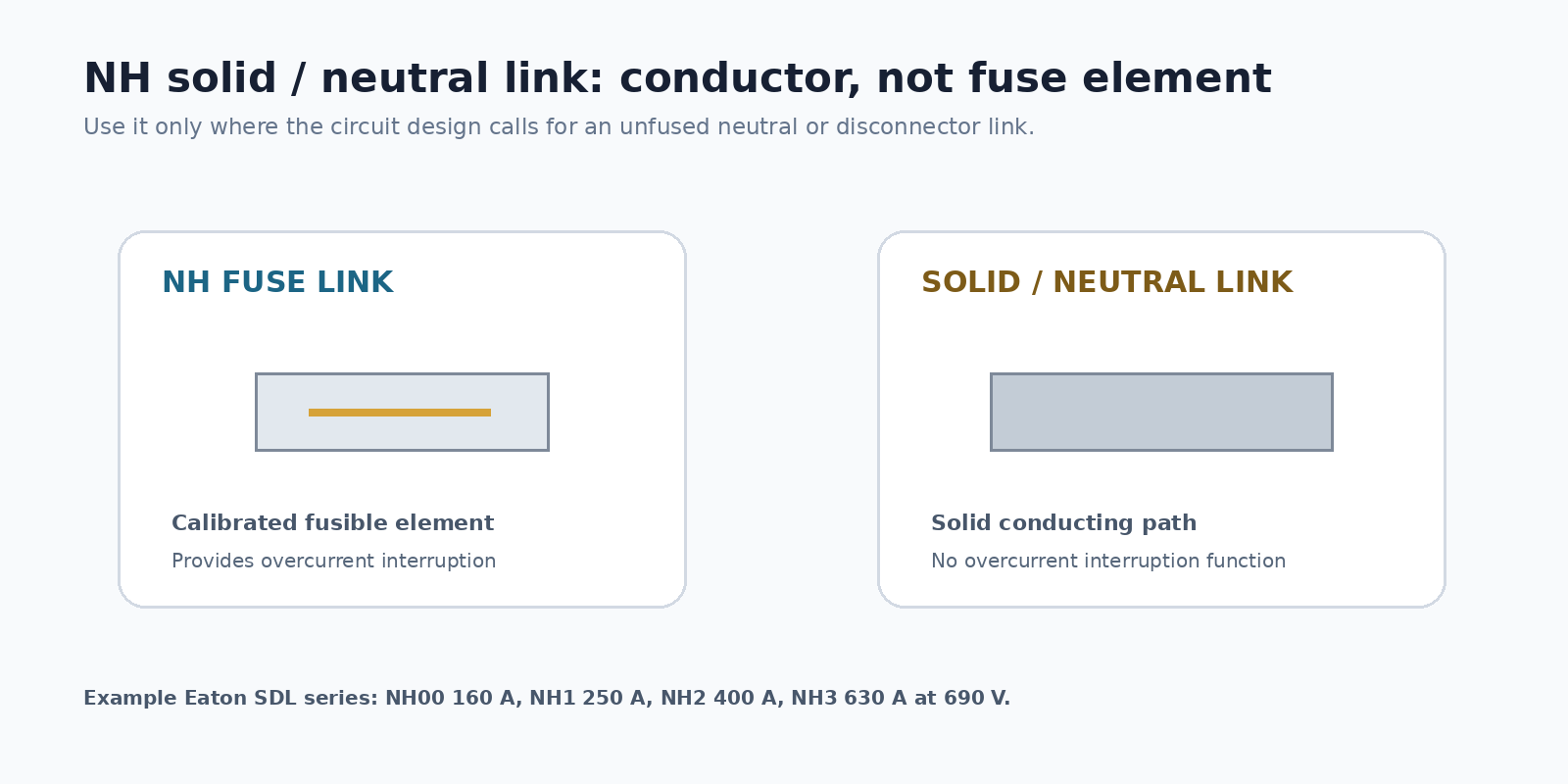
A solid link is not a fuse. It provides a low-resistance current path through an NH base position without an intentional fusible overcurrent element. Eaton’s current SDL range gives representative ratings of:
A neutral link is appropriate where the distribution design calls for an unfused neutral connection through the same NH hardware. It should not be replaced with an ordinary fuse simply because a fuse link fits the position.
The safety reason needs to be stated carefully. In a three-phase four-wire system with unbalanced single-phase loads, an unintended open neutral can shift the neutral point and expose some loads to substantial overvoltage, potentially approaching line-to-line voltage. That is why neutral continuity and coordinated neutral switching are critical.
However, “the neutral must never contain any protective or switching device” is too absolute. Electrical standards permit or require neutral switching in particular system arrangements, provided the device operates in the required coordinated manner and the earthing/system rules are satisfied. The engineering rule for an NH board is: use the neutral/solid link or switched-neutral arrangement specified by the system design; do not substitute a fuse or improvised busbar without an engineered basis.
A damaged solid link should be replaced by the correct rated accessory, not by a piece of random copper. Contact geometry, current rating and mechanical fit remain part of the base system.
Mounting, accessories and operation
NH links with live gripping lugs are intended to be handled with the correct fuse replacement device by authorized personnel. Mersen explicitly describes the NH system as one for professional/qualified handling because the system does not inherently prevent every possible higher-current link from being inserted within a compatible physical size.
Eaton’s current product range includes extraction handles, shrouds, phase barriers, microswitches and IP20 protection kits. Those accessories matter because an open NH base without shrouding is typically IP00.
Mounting also affects thermal and mechanical performance. Follow the base manufacturer’s specified terminal torque, DIN-rail or screw-fixing method, conductor range and temperature derating. High-current NH equipment should not be treated as a generic clip holder that can be mounted loosely wherever space is available.
For replacement, de-energize where required by the equipment and work procedure, use the correct extraction tool and PPE, and follow the facility’s qualified-person electrical safety rules.
Official product references
For real product appearance, use manufacturer product media rather than AI-generated product photos:
- Eaton 100NHG1B, NH1 100 A 500 V gG: https://www.eaton.com/us/en-us/skuPage.100NHG1B.html
- Eaton 100NHG00B-690, NH00 100 A 690 V gG: https://www.eaton.com/us/en-us/skuPage.100NHG00B-690.html
- Eaton 800NHG4B-690, NH4 800 A 690 V gG: https://www.eaton.com/us/en-us/skuPage.800NHG4B-690.html
- Eaton SDL-1 neutral/solid link: https://www.eaton.com/us/en-us/skuPage.SDL-1.html
- Eaton NH fuse bases data sheet: https://www.eaton.com/content/dam/eaton/products/electrical-circuit-protection/bussmann-iec-low-voltage-fuses/bussmann-iec-nh-fuse-bases-and-gear/eaton-bussmann-series-nh-bases-datasheet-10163-en-us.pdf
- Eaton NH catalog: https://www.eaton.com/content/dam/eaton/products/electrical-circuit-protection/bussmann-iec-low-voltage-fuses/bussmann-iec-nh-fuses/eaton-bussmann-series-nh-fuses-catalogue-ca132063-en-gb.pdf
No AI-generated product photo is used in this article.
Frequently asked questions
Which IEC standard covers NH fuses?
IEC 60269-2, together with the general requirements of IEC 60269-1. IEC 60269-2 explicitly defines NH fuse systems with blade-contact links, striker links, fuse rails and busbar-mounted bases.
Is NH2 a 2 amp fuse?
No. NH2 is a physical construction size. The ampere rating is a separate value printed on the fuse link.
What does gG mean?
The first “g” means full-range breaking capacity; the “G” identifies general application. gG provides overload and short-circuit protection when correctly selected.
What does aM mean?
“a” means partial-range breaking capacity and “M” means motor application. aM is primarily short-circuit protection and needs a separate overload-protection function.
Must the fuse link and base come from the same manufacturer?
Not automatically. NH is a standardized IEC system. Cross-manufacturer use can be legitimate when size, ratings, power dissipation and application requirements are satisfied. Check the base and fuse data rather than relying only on physical fit.
What is an NH neutral link?
It is a solid conducting link used in an NH base position where the design calls for an unfused neutral/disconnector path. It has no intentional fuse element and should not be treated as an overcurrent protective device.
What breaking capacity is typical?
Use the exact product data. Current Eaton 500 V and 690 V gG NH products commonly publish 120 kA breaking capacity; specialized higher-voltage variants can differ.