


IEC 60269 vs UL 248 Fuse Standards: Categories, Classes, Ratings and Cross-Market Selection

IEC 60269 and UL 248 are both mature fuse standards frameworks, but they organize products differently enough that “find the equivalent fuse” is usually the wrong first question.
A North American UL fuse class can define a dimensional envelope, electrical ratings and class-specific performance requirements. An IEC utilization category such as gG, aM, aR or gPV describes breaking range and application, while the IEC system also has standardized physical fuse systems such as NH, cylindrical and other industrial arrangements.
So the difference is not “UL uses physical classes while IEC only uses time-current categories.” Both systems contain physical and performance requirements. They simply package those requirements differently.
A fuse can also carry approvals from more than one system. A UL mark does not prevent a product from also being designed to an IEC standard, and an IEC-designed product may also obtain a North American certification. What matters is the exact catalog number and the marks/ratings actually held by that product.
How the IEC 60269 framework is organized

The current IEC 60269-1:2024 provides the general requirements. Its scope covers enclosed current-limiting fuse-links with rated breaking capacities of at least 6 kA for AC circuits up to 1000 V and DC circuits up to 1500 V.
IEC 60269 then adds application-specific parts.
IEC 60269-2 covers supplementary requirements for fuses used by authorized persons, mainly industrial applications. The current consolidated version contains standardized fuse systems A through K, including NH blade-contact fuse systems and other defined physical arrangements.
IEC 60269-3 covers fuses for operation by unskilled persons, mainly household and similar applications. The current 2024 edition applies to gG fuse systems in that scope. It is not the transformer-protection part described in the source draft.
IEC 60269-4 adds requirements for fuse-links protecting semiconductor devices.
IEC TR 60269-5 is an application guidance Technical Report. It is not a product standard for special “high prospective short-circuit equipment.”
IEC 60269-6 covers photovoltaic fuse-links for strings and arrays, with the current published scope extending to 1500 Vdc.

This structure is important because it prevents a common mistake: reading an IEC part number as though it directly names a protection category. The part establishes the product/application scope; utilization categories are a separate layer.
IEC utilization categories: g and a are breaking ranges
The first lower-case letter in an IEC utilization category is not a generic “speed” letter.
g means full-range breaking capacity. A g fuse is intended to break currents from its conventional low-overcurrent operating region up through its rated breaking capacity.
a means partial-range breaking capacity. An a fuse is a backup device intended to interrupt currents above its specified minimum breaking current, so another device normally handles the lower-overcurrent region.
The second letter or designation identifies the application.
Common examples include:
There is no general IEC first-letter t category meaning “time delay” in the way the source draft states. Time-current behavior is defined by the applicable utilization category and product data.
How the UL 248 framework is organized
UL 248 is also a multi-part standard. The current structure is more specific than the source draft’s table.
Key low-voltage parts include:
Several corrections follow immediately.
UL 248-5 is Class G only. It does not cover Class E, G and H together.
UL 248-17 is Class CF, not a Class D / NEMA Type D standard.
Class CD is UL 248-18. The active 2026 edition applies to Class CD fuses rated 31–60 A and 600 Vac.
Plug fuses are UL 248-11, rated 30 A or less and 125 Vac (127 Vac for Mexico). This is where Edison-base and Type S residential plug fuses belong.
A low-voltage “Class E screw-in 600 V” entry should not appear in a current UL 248 class table. E-Rated is a medium-voltage ANSI/IEEE fuse designation, which is a completely different standards family.
UL class does not always tell you the time-delay characteristic
A UL class defines a fuse family’s standardized requirements, dimensions and electrical envelope, but product series within the class can still have different time-current behavior.
Class J is a good example. Eaton sells LPJ dual-element time-delay Class J fuses and JKS fast-acting Class J fuses. Both are Class J. Therefore, “Class J curve” is not one universal curve.
Class R is another example. RK1 and RK5 both sit within Class R but offer different degrees of current limitation and series-specific time-current performance.
Time-delay marking is therefore a product characteristic within a class, not something that can always be inferred from the class letter alone.
Representative UL class envelopes
A few current standards scopes illustrate how class-specific the voltage/current envelope is:
- Class CC — UL 248-4: 30 A or less, 600 Vac; DC optional.
- Class G — UL 248-5: 20 A or less at 600 Vac; 21–60 A at 480 Vac; DC optional.
- Class J — UL 248-8: 600 A or less, 600 Vac; DC optional.
- Class L — UL 248-10: 100–6000 A, 600 Vac; DC optional.
- Class R — UL 248-12: 600 A or less, 250 or 600 Vac; DC optional.
- Class T — UL 248-15: 1200 A or less, 300 or 600 Vac; DC optional.
- Class CD — UL 248-18: 31–60 A, 600 Vac.
- PV — UL 248-19: photovoltaic fuses, with the 2024 revision extending scope to 2000 Vdc.
These are standard scopes, not a substitute for the catalog marking. A specific fuse may have a lower or additional DC rating and a particular interrupting rating that must be read from its datasheet.
Physical non-interchangeability and rejection
North American classes frequently use distinct dimensions or rejection features to reduce the chance of installing an inappropriate fuse.
Class R rejection holders, for example, are designed to reject lower-performance Class H/K-type fuses. Class G uses rating-dependent dimensions that provide size rejection. Class J, T, CC and other classes have their own dimensional systems.
But it is too broad to say every UL class contains the same kind of “rejection scheme.” The mechanism differs by class.
IEC systems also use mechanical non-interchangeability. IEC 60269-3 specifically describes mechanical solutions that prevent installation of a higher-current fuse-link in household/unskilled-person systems. NH and other IEC fuse systems have standardized dimensions and matching bases.
The design principle is common to both worlds: physical compatibility is part of safe application, but the way it is achieved differs.
Voltage and breaking capacity across IEC and UL systems
The current IEC 60269-1 low-voltage scope extends to 1000 Vac and 1500 Vdc, which gives IEC product families access to system voltages above the 600 Vac ceiling of many mainstream UL branch-circuit classes.
That does not mean an IEC fuse “has a higher voltage class” by default. The actual product rating still governs.
Likewise, a UL fuse with a 600 Vac class scope may have a separate DC voltage rating that is substantially different. DC capability must always be read explicitly.
Breaking or interrupting rating is also product- and voltage-specific. Do not assume that interrupting capability must always fall by half when voltage rises; some fuse families maintain the same high breaking capacity across multiple rated voltages, while others change. Use the exact datasheet.
The important cross-market rule is:
voltage rating, interrupting/breaking rating, time-current behavior, dimensions and certification all have to be revalidated separately.
Certification: UL, IEC, CE and CB are different concepts
IEC writes international standards; IEC does not place a universal “IEC certified” mark on every compliant fuse.
Products designed to IEC standards may be supported by manufacturer declarations, national certification marks, third-party certifications or the IEC System for Conformity Assessment Schemes such as the IECEE CB Scheme, depending on the product and market.
CE marking is an EU regulatory conformity mark where the applicable EU legislation requires it. CE is not the same thing as “IEC certification,” and complying with IEC 60269 is only one possible technical route within a broader product-conformity process.
In North America, UL is one certification organization and NRTL. Many products are UL Listed or UL Recognized, but the legal requirement is not universally “must have UL specifically.” Applicable codes, product standards, the Authority Having Jurisdiction and NRTL certification requirements determine what is accepted.
The phrase “UL approved” should be avoided because it is not the normal certification category. Use the actual mark: Listed, Recognized Component, Certified or another stated certification.
A single fuse can also hold multiple approvals. Therefore, “UL-listed fuse carries no IEC conformity” is not a safe blanket statement. The correct statement is: one approval does not imply the other; inspect the exact product’s certifications.
Crossing a machine from one market to another
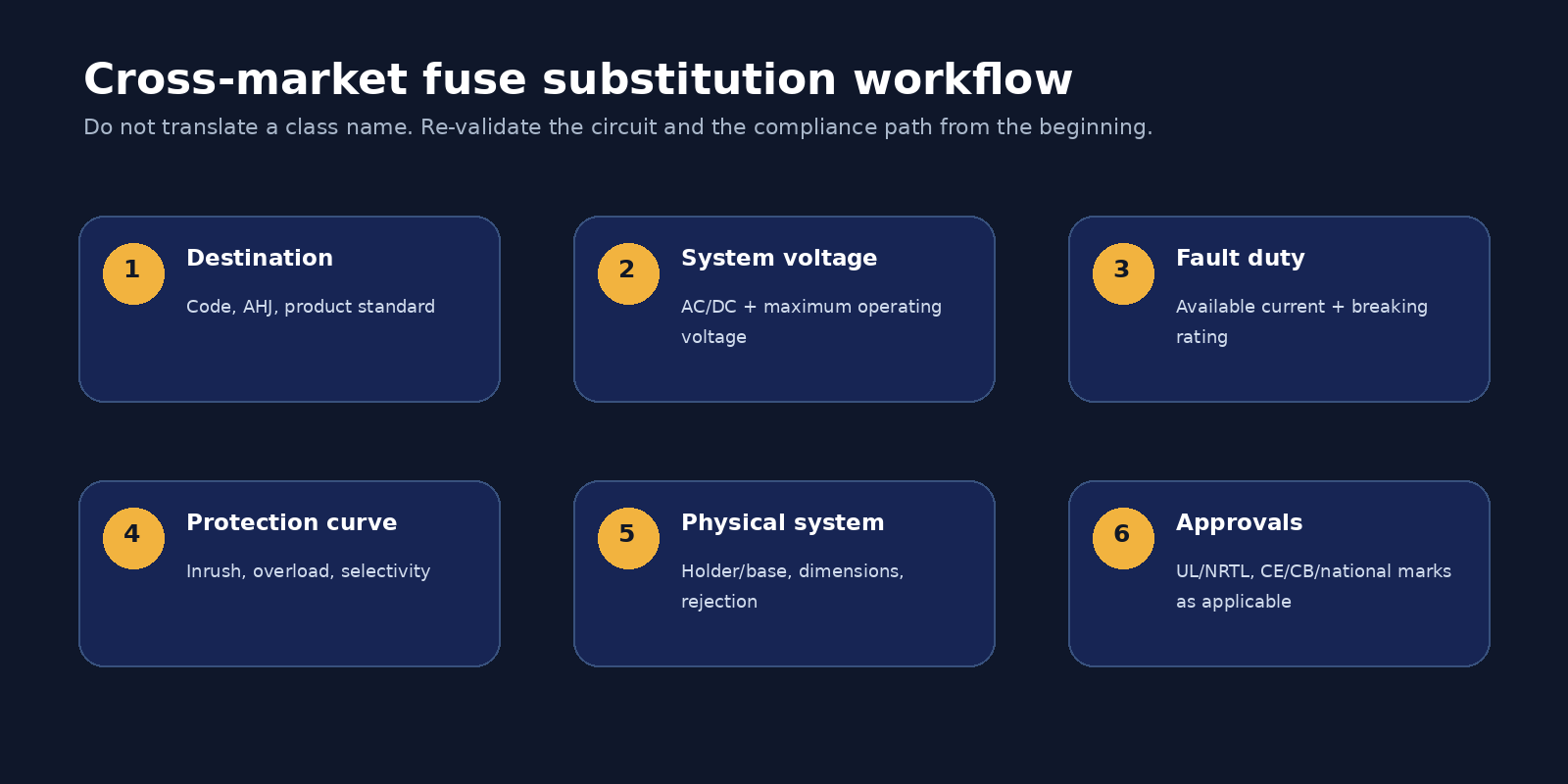
Suppose a European machine uses a 63 A gG fuse on a 400 V three-phase circuit and the same machine platform is being redesigned for North America.
Do not begin by asking “what UL class equals gG?” There is no direct equivalent.
Start with the destination-market requirements. Determine whether the equipment will remain a 400 V internally derived system or will actually be connected to a 480 V supply. A machine does not become 480 V merely because it is shipped to the United States.
Then recalculate the available fault current at the actual installation voltage and source.
Next, decide which UL/North American fuse family provides the required function. A time-delay Class J, RK1 or RK5 product may be a candidate depending on the load, but its time-current curve must be rechecked against inrush and conductor/equipment protection.
The holder and panel layout change because the physical systems are different.
Finally, verify the actual certification requirements of the destination assembly and the exact fuse/holder combination. If a dual-certified product is available, it may simplify the redesign; if not, the panel protection architecture may need to change.
No one-to-one class/category table
The temptation to publish a cross-reference such as “Class J = gG” should be resisted.
A Class J time-delay fuse and a gG NH fuse can both protect general industrial feeders, but they differ in dimensions, holder, marking, exact TCC, interrupting ratings, certification and available ampere ratings.
Likewise, aR semiconductor fuses in IEC 60269-4 do not map to one specific North American branch-circuit class. UL 248-13 provides a semiconductor-fuse standard, but the actual fuse still needs to be selected by voltage, current, I²t, let-through and physical format.
The useful cross-market comparison is functional, not a substitution table:
That table identifies engineering roles, not interchangeable parts.
Common mistakes
The first mistake is treating the IEC system as categories only. IEC 60269 also standardizes physical fuse systems.
The second is assuming a UL class uniquely defines time delay. Class J alone does not tell you whether the selected series is fast-acting or time-delay.
The third is using the wrong UL 248 part number. Class G is -5, Class CF is -17, Class CD is -18 and PV is -19.
The fourth is placing E-Rated medium-voltage fuses inside a low-voltage UL 248 class table.
The fifth is stating that IEC 60269-3 covers transformer fuses. It covers unskilled-person household/similar fuse systems.
The sixth is treating IEC TR 60269-5 as a product standard. It is application guidance.
The seventh is assuming certification is mutually exclusive. A product may be dual-certified; verify the exact marks.
The eighth is assuming all DC ratings are a fixed fraction of AC ratings. They are not. Read the catalog.
The ninth is changing a European 400 V design to “480 V” on paper solely because the destination is North America. Use the actual supply architecture.
Official standards references
- IEC 60269-1:2024: https://webstore.iec.ch/en/publication/66096
- IEC 60269-2 consolidated edition: https://webstore.iec.ch/en/publication/96037
- IEC 60269-3:2024: https://webstore.iec.ch/en/publication/71454
- IEC 60269-4:2024: https://webstore.iec.ch/en/publication/66094
- IEC TR 60269-5: https://webstore.iec.ch/en/publication/68251
- IEC 60269-6: https://webstore.iec.ch/en/publication/68843
- UL fuse and fuseholder services / class overview: https://www.ul.com/services/fuse-and-fuseholders-services
- UL 248-5 Class G: https://www.shopulstandards.com/ProductDetail.aspx?UniqueKey=9444
- UL 248-8 Class J: https://www.shopulstandards.com/ProductDetail.aspx?UniqueKey=22850
- UL 248-10 Class L: https://www.shopulstandards.com/ProductDetail.aspx?UniqueKey=50229
- UL 248-12 Class R: https://www.shopulstandards.com/ProductDetail.aspx?UniqueKey=22853
- UL 248-13 Semiconductor Fuses: https://www.shopulstandards.com/ProductDetail.aspx?productId=UL248-13
- UL 248-15 Class T: https://www.shopulstandards.com/ProductDetail.aspx?productId=UL248-15
- UL 248-17 Class CF: https://www.shopulstandards.com/ProductDetail.aspx?UniqueKey=34912
- UL 248-18 Class CD: https://www.shopulstandards.com/ProductDetail.aspx?UniqueKey=42541
- UL 248-19 Photovoltaic Fuses: https://www.shopulstandards.com/ProductDetail.aspx?UniqueKey=30295
No AI-generated product photo is used in this article.
Frequently asked questions
Is IEC gG equivalent to UL Class J?
No. They can fill similar general-purpose protection roles, but they are not one-to-one equivalents and are not mechanically interchangeable.
What does the first letter in gG or aM mean?
It identifies the breaking range: g is full range; a is partial range. It is not a generic speed scale.
Which IEC 60269 part covers NH fuses?
IEC 60269-2 contains the industrial/authorized-person standardized fuse systems, including NH blade-contact systems.
Which IEC part covers household fuse systems?
IEC 60269-3 covers fuse systems operated by unskilled persons for household and similar applications.
Which UL 248 part covers Class G?
UL 248-5.
Which part covers Class CD?
UL 248-18. UL 248-17 is the Class CF Outline of Investigation.
Is Class E a low-voltage UL 248 fuse class?
Not in the sense used by the source draft. E-Rated is a medium-voltage ANSI/IEEE designation. Residential Edison-base plug fuses are covered under UL 248-11.
Does a UL mark automatically satisfy IEC requirements?
No. But a product can carry both North American and IEC-related approvals. Check the exact catalog number rather than assuming the certification systems are mutually exclusive.