



Bussmann Fuse Selection Guide: 7 Popular Series Compared

Class CC vs. CF vs. J vs. RK1 vs. RK5 vs. T: compare interrupting ratings, time-delay characteristics, applications and replacement considerations before you place an order.
Includes verified Eaton product references

Choosing an industrial fuse is not simply a matter of matching amperage. Two Bussmann fuses can look similar—or both carry the Low-Peak name—while having different interrupting ratings (IR), voltage ratings, time-current characteristics and physical footprints.
A wrong substitution can create nuisance interruptions, invalidate an equipment evaluation or leave a circuit without the intended short-circuit protection. This guide starts with seven widely encountered Eaton Bussmann series, then explains the checks that matter in real purchasing decisions.
1. Bussmann Fuse Comparison: Seven Common Series
The figures below are family-level reference values for common AC variants. Always check the exact part number and its latest datasheet, especially for DC ratings, indicating options and special sub-ranges.
| Series | UL Class | Typical AC rating | AC interrupting rating | Action | Typical use |
|---|---|---|---|---|---|
| LP-CC Low-Peak |
CC | 600 Vac; ½–30 A | 200 kA | Time-delay | Control circuits and compact branch protection |
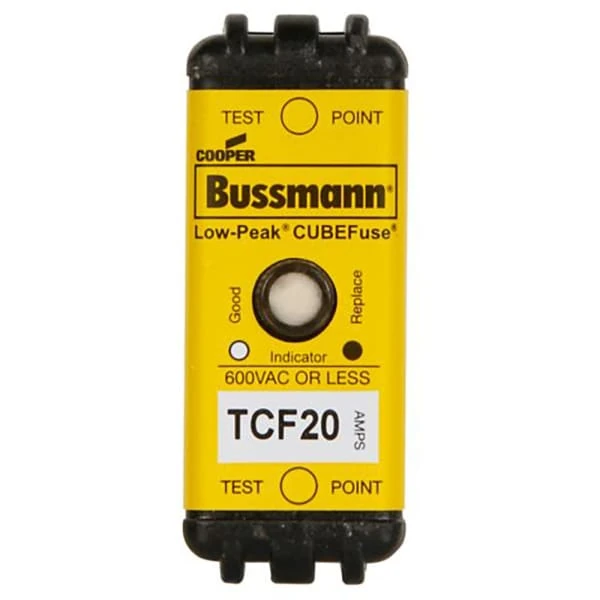
| TCF CUBEFuse |
CF | 600 Vac; 1–400 A | 300 kA (1–100 A) 200 kA (110–400 A) |
Time-delay | Space-efficient panels and distribution |
| LPJ Low-Peak |
J | 600 Vac; 1–600 A | 300 kA | Time-delay | Feeders, motor circuits and industrial panels |
| LPS-RK Low-Peak |
RK1 | 600 Vac; 1/10–600 A | 300 kA | Time-delay | Existing Class R installations, motor feeders |
| FRS-R Fusetron |
RK5 | 600 Vac; 1/10–600 A | 200 kA | Time-delay | Maintenance and legacy RK5 replacements |
| KTN-R Limitron |
RK1 | 250 Vac; 1–600 A | 200 kA | Fast-acting | Non-inductive equipment at 250 Vac |
| JJS Limitron |
T | 600 Vac; 1–800 A | 200 kA | Fast-acting | Compact power distribution and non-inductive loads |
Related variants: LPN-RK (250 Vac Class RK1), FRN-R (250 Vac Class RK5), JJN (300 Vac Class T), and KRP-C (Class L, typically 601–6000 A). The listed current ranges describe families, not every stocked catalog number.
2. Does “Low-Peak” Always Mean a 300 kA Interrupting Rating?
No. Low-Peak is a product family designation, not a uniform interrupting-rating specification. This is particularly important for two frequently ordered series:
| Fuse / rating band | 600 Vac AC IR | What to remember |
|---|---|---|
| LP-CC (Class CC) | 200 kA | Do not describe it as a 300 kA fuse |
| TCF (Class CF), 1–100 A | 300 kA | Verify exact catalog number |
| TCF (Class CF), 110–400 A | 200 kA | Higher-current versions have a different IR |
| LPJ (Class J) | 300 kA | Applicable to the referenced LPJ time-delay family |
| LPS-RK (Class RK1) | 300 kA | Confirm voltage and corresponding LPN/LPS model |

3. Three Fuse Characteristics You Should Never Ignore
Interrupting rating (IR): Can the fuse clear the available fault current?
IR is the maximum prospective fault current a fuse is rated to interrupt at its specified voltage and test conditions. The selected device must have an appropriate rating for the available short-circuit current at its point of installation. A high rating provides flexibility, but it is not a substitute for a fault-current study.
Current limitation: How much fault energy reaches downstream equipment?
Current-limiting fuses can reduce peak let-through current and clearing energy during qualifying high-level faults. Those benefits may help protect contactors, wiring and other downstream equipment. However, a fuse’s interrupting rating is not the same as an industrial control panel’s short-circuit current rating (SCCR). Any SCCR increase must follow an accepted evaluation method, such as applicable UL 508A Supplement SB procedures, together with verified component and combination ratings.
Time delay: Can the circuit ride through normal inrush?
Motors, transformers and some power supplies briefly draw more than their steady-state current. A properly selected time-delay fuse may tolerate this normal inrush while still providing overload and short-circuit protection. Fast-acting fuses are useful where intentional delay is undesirable, but they should not be chosen solely because “faster sounds safer.” Actual suitability depends on the load’s time-current profile, protection requirements and manufacturer curves.
4. Type 2 Coordination: Why a Fuse Alone Cannot Guarantee It
For motor starters, IEC Type 2 coordination generally aims to prevent danger to people or the installation and permit continued service after a short circuit, subject to the standard’s permitted contact welding and required checks. Type 2 coordination applies to a tested or documented combination—not to every installation using a particular Class J or RK1 fuse.
When evaluating a starter, confirm the exact fuse or short-circuit protective device, contactor, overload relay, operational voltage and prospective short-circuit current shown in the manufacturer’s coordination tables. Do not promise a particular post-fault downtime or automatic restart based on fuse class alone.
5. Which Bussmann Fuse Should You Choose?
| Your application | Series to investigate | Primary checks |
|---|---|---|
| Compact control circuit, 30 A or less | LP-CC | 600 Vac, 200 kA IR, load inrush and correct Class CC holder |
| Space-constrained distribution panel | TCF CUBEFuse | Current-dependent IR, matching mounting hardware and installed finger-safe requirements |
| Industrial feeder or motor branch circuit | LPJ Class J | 300 kA IR, proper time-current coordination and Class J fuseholder |
| Existing Class R installation | LPS-RK or FRS-R | Installed holder, rejection feature, voltage and protection curve |
| Fast-acting protection for non-inductive circuits | KTN-R or JJS | Voltage class, starting currents, manufacturer curve and replacement dimensions |
| Very high-current distribution | KRP-C Class L | Exact ampere rating, bolted mounting, conductor arrangements and system study |
A six-step purchasing checklist
- Identify the circuit: motor, transformer, feeder, control power or other load.
- Confirm system voltage: AC and DC approvals are not interchangeable.
- Determine available fault current: choose a sufficient interrupting rating.
- Check the time-current curve: consider inrush, overload and coordination.
- Verify the physical interface: UL fuse class, holder, rejection features and dimensions.
- Review panel and starter documentation: confirm SCCR and any claimed coordination rating.
6. Two Easily Missed Details
DC ratings and indicator options
An AC-rated catalog family does not automatically have identical DC capability across all amperages and indicating variants. For example, Eaton’s LP-CC-10 is specified for 150 Vdc, while another LP-CC amperage may carry a different DC voltage rating. Confirm the precise SKU before ordering for battery, storage or DC distribution systems.
Finger-safe construction depends on the installed assembly
CUBEFuse can be part of a compact, finger-safe arrangement, but that does not mean every exposed fuse installation is touch-safe. The final holder, disconnect, protective shrouds and rated installation must be evaluated together; certain higher-current CF arrangements require additional shrouding.
7. Frequently Asked Questions
Can I replace a Class RK5 fuse with a Class RK1 fuse?
Possibly, but not solely because the dimensions appear similar. Confirm the holder’s rejection features, physical fit, voltage and ampere ratings, time-current performance and equipment approvals. The upgrade should be approved for the particular circuit.
Are Class J and Class CC fuses interchangeable?
No. They have different class-specific dimensions and mounting arrangements. Their holders should not be treated as interchangeable.
Does a 300 kA fuse automatically give a panel a 300 kA SCCR?
No. The panel SCCR depends on the complete assembly and applicable evaluation rules. A high-IR fuse may be a helpful part of a compliant design, but does not set panel SCCR by itself.
Is a fast-acting fuse always better than a time-delay fuse?
No. A fast-acting fuse may suit circuits without substantial normal inrush. Time-delay designs are often considered for inductive loads, subject to the required protective coordination.
Where do I find accurate I²t and let-through information?
Use the specific manufacturer’s current-limitation curves, time-current data and technical support. Do not apply a universal conversion factor across unrelated curves or products.
8. Final Takeaway
The best Bussmann fuse is not simply the one with the highest advertised interrupting rating. A reliable selection matches voltage, current, fault level, time-current response, fuse class, holder and system coordination. For purchasing teams, recording the complete catalog number is just as important as recording the fuse class.
Where to go next
Every rating on this page maps to a catalog record on fusestock.com — check a part number, find a cross-reference, or price a mixed-brand list.
Bussmann series index — 452 seriesEvery factory series in one table, each row linked to its datasheet.
ABB ↔ Cooper current-limiting fusesPublished substitution table for medium-voltage backup fuses.
UL / CSA low voltage fusesClass CC, CF, J, RK1, RK5 and midget — 6,691 records.
Holders, blocks and reducersThe half of the order that decides whether the fuse actually fits.
How fuse ratings actually workVoltage, interrupting rating and time-current curves, explained.
Send a part number or a mixed BOMQuoted against real catalog records, not a price list.