



MIDI vs ANL vs MEGA Fuses: Bolt-Down Fuse Selection for Automotive, Marine and Low-Voltage DC

MIDI vs ANL vs MEGA Fuses: Bolt-Down Fuse Selection for Automotive, Marine and Low-Voltage DC
MIDI, ANL and MEGA are all high-current bolt-down fuse styles, but that is where the easy comparison ends.
They do not share one universal body size. Their mounting pitch is different, their current ranges differ, and their time-current behavior can be completely different. A fuse that looks similar enough to sit between two studs may still be the wrong product electrically and mechanically.
The safe rule is:
Select the exact fuse family from the holder, voltage, available fault current, conductor protection requirement and time-current characteristic. Never cross-reference MIDI, ANL and MEGA by appearance alone.
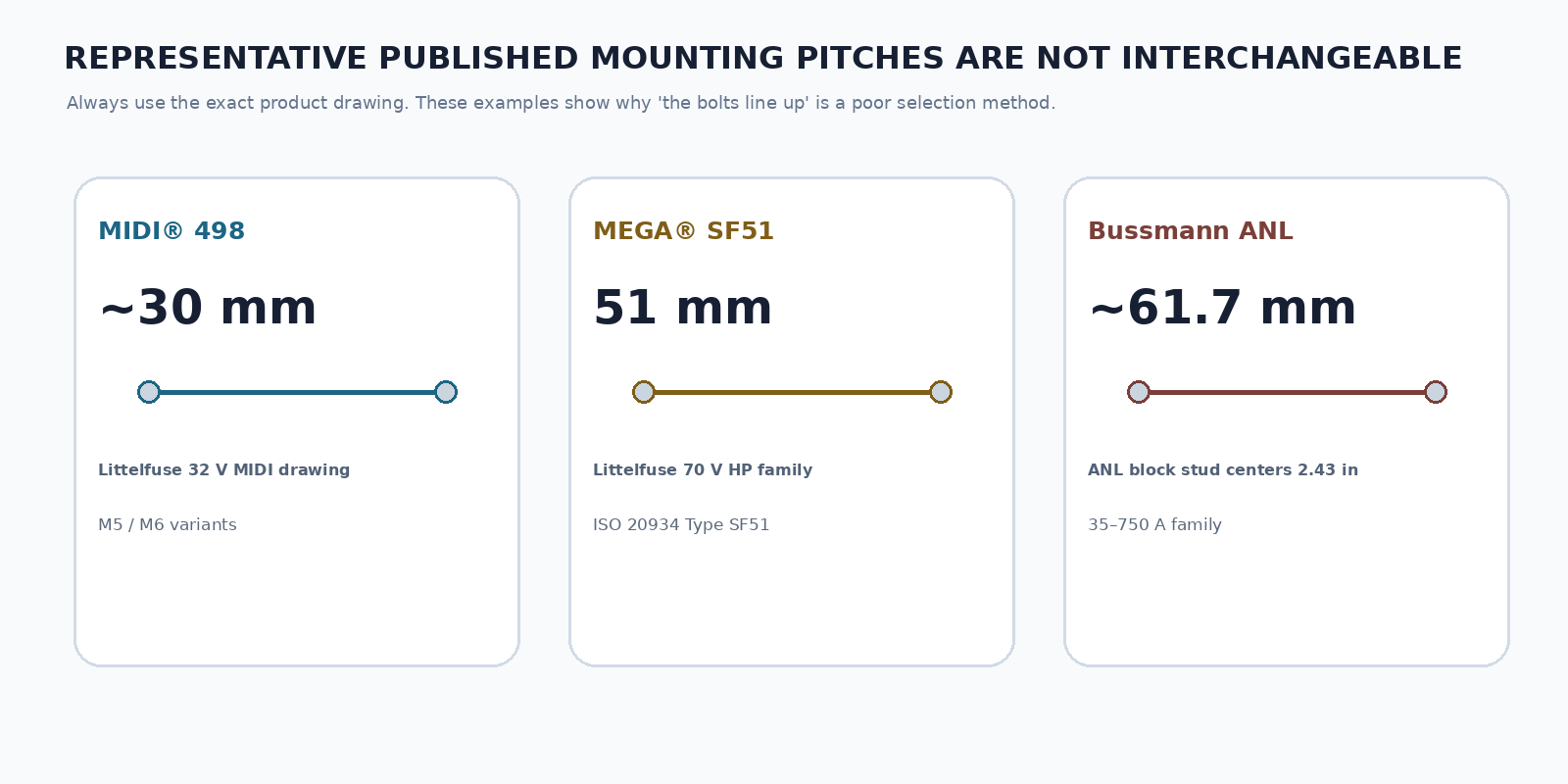
MIDI, ANL and MEGA are distinct dimensional systems
The source draft treats MIDI and ANL as nearly the same body and suggests that their bolts often align. Current manufacturer drawings show why that is not a reliable assumption.
A current Littelfuse 32 V MIDI drawing shows an approximately 30 mm hole-center span for the common two-hole version. Littelfuse’s 70 V MEGA High Performance SF51 family uses a 51 mm pitch as part of its standardized mechanical coding. Eaton’s Bussmann ANL data lists recommended fuse-block stud centers of approximately 2.43 in, or 61.7 mm.
Those are three materially different mounting systems.
The exact values vary with series, one-hole/two-hole configuration and voltage family, so the final check must always use the current product drawing. But the broader conclusion is strong:
MIDI, MEGA and ANL are not interchangeable simply because all three are flat bolt-down fuses.
Electrical behavior differs just as much as the dimensions

Representative current manufacturer data makes the point clear:
This destroys another common shortcut: “MIDI is the smaller version, ANL is roughly the same thing, and MEGA is just a larger rating.”
The correct interpretation is that they are different product families with different mechanical and electrical definitions.
MIDI: compact time-delay protection
Littelfuse’s 498 MIDI family is designed for high-current wiring harnesses and uses diffusion-pill technology to provide time-delay behavior.
The current 32 V data sheet lists:
- 30–200 A range;
- 2 kA interrupting rating at 32 Vdc;
- -40 °C to +125 °C recommended environmental temperature;
- M5 or M6 mounting versions;
- reference to ISO 8820-5;
- time-delay behavior.
One important limitation is easy to miss: Littelfuse states that 150–200 A MIDI ratings should be used only for short-circuit protection. At those ratings, do not assume the fuse will provide full overload protection for the conductor simply because its nameplate ampere rating looks close to the cable ampacity.
This is a good example of why conductor protection must be checked against the manufacturer’s TCC and the applicable wiring standard, not a one-line rule.
MEGA: higher-current time-delay protection
The standard 32 V Littelfuse MEGA family is also time-delay and covers a wider high-current range. Current manufacturer information lists:
- 40–500 A;
- 2 kA interrupting rating at 32 Vdc;
- ISO 8820-5 compliance;
- time-delay operation;
- battery, alternator and heavy-gauge harness applications.
Again, the high-current end needs special attention: Littelfuse states that 300–500 A MEGA ratings are for short-circuit protection only.
For higher-voltage 48 V-class architectures, current MEGA High Performance families extend to 70 Vdc. The SF51 example publishes:
- 60–500 A;
- 70 Vdc;
- 2.5 kA interrupting rating;
- 51 mm mechanical pitch;
- ISO 20934 Type SF51 reference.
Do not transfer a 70 V rating to a standard 32 V MEGA part merely because the body looks familiar.
ANL: a different limiter family
Eaton Bussmann ANL is a different product concept.
Current ANL data identifies it as a non-time-delay low-voltage limiter for battery-operated systems, with:
- 35–750 A range;
- up to 80 Vdc;
- 2.7 kA DC interrupting rating;
- approximately 61 mm fuse-block stud spacing;
- no time-delay claim.
That makes ANL behavior different from the common MIDI and MEGA time-delay families.
If an inrush-heavy load was designed around a time-delay MIDI or MEGA fuse, replacing it with an equal-ampere ANL is not an equivalent substitution. The body will not be the same, and the TCC will not be the same.
The most important electrical limit: interrupting rating
In a low-voltage lead-acid vehicle circuit, a 2 kA or 2.7 kA interrupting rating may be adequate depending on the source and wiring impedance.
In a modern low-resistance lithium battery system, the available short-circuit current can be much higher.
That is why a low-voltage fuse’s interrupting rating cannot be ignored just because the system is “only 12 V, 24 V, 48 V or 70 V.”
The selection sequence is:
- calculate or obtain the prospective fault current at the fuse location;
- verify the fuse voltage rating;
- verify the DC interrupting rating at that voltage;
- if the available fault current exceeds the fuse rating, move to a higher-interrupting-capability automotive or EV fuse family.
Eaton, for example, now offers newer bolt-down automotive fuse families with much higher voltage and interrupting ratings for modern battery systems. Those should not be confused with legacy ANL simply because both use bolted terminals.
Protect the conductor—not just the load
The source draft states that “fuse rating must be ≤ cable ampacity and ≥ load” as an absolute binary rule. The intent is good, but the engineering needs more nuance.
The conductor is normally one of the assets the fuse protects, but the permitted OCPD rating depends on the applicable automotive, marine, OEM or equipment standard, conductor insulation, temperature, bundling, routing and the fuse time-current characteristic.
The real protection requirement is:
The conductor must survive the current-time profile that the fuse allows before clearing, and the fuse must carry the legitimate load and inrush.
For a simple low-voltage harness, that often leads to a fuse rating close to the conductor’s permitted continuous ampacity. But at the high end of MIDI and MEGA families, the manufacturer may explicitly classify the fuse as short-circuit protection only, which means overload protection must be handled by the system design rather than assumed from the fuse.
Inrush is solved with the time-current characteristic, not blind upsizing
Starter motors, compressors, inverters, pumps and capacitive DC loads can draw several times normal current for a short period.
If the fuse opens during normal inrush, the first engineering response should be to compare the actual inrush envelope with the fuse TCC.
A time-delay MIDI or MEGA fuse may survive an inrush that a non-time-delay ANL of the same ampere rating does not.
Do not simply install a fuse several times larger than the load. Upsizing changes the fault protection of the cable and can move the design outside the manufacturer’s intended operating range.
Fuse placement near the source matters
A fuse protects only the conductor downstream of the fuse.
In a battery system, an unfused cable between the battery terminal and the fuse is still exposed to the battery’s full short-circuit capability. That makes fuse placement part of the protection design.
Place the primary conductor-protection device as close to the energy source as the applicable vehicle, marine, OEM or equipment standard requires, while still meeting serviceability and environmental constraints.
The exact permitted distance is standard- and application-dependent, so avoid publishing one universal inch or millimeter value for automotive, marine and industrial systems.
Holder, studs, lugs and torque are part of the fuse system
A bolt-down fuse depends on its terminations.
A perfectly selected fuse can still overheat if:
- the wrong body is forced into the holder;
- the stud size is wrong;
- ring terminals do not sit flat;
- washers are stacked incorrectly;
- the connection is under-torqued or over-torqued;
- corrosion increases contact resistance.
Use the holder/fuse manufacturer’s specified torque. Do not borrow a torque value from a different MIDI, MEGA or ANL family.
The current Littelfuse MIDI 32 V data, for example, publishes different torque values for M5 and M6 versions. Its MEGA families use different M6/M8 values. Those numbers belong to the specific product family and hardware.
Thermal derating and environment
These fuses are often installed in the worst thermal locations on the vehicle: battery boxes, engine compartments, sealed power distribution modules and machinery enclosures.
The fuse’s nameplate current is not an ambient-temperature correction table.
Use the manufacturer’s temperature data and application guidance for the actual product. Consider:
- ambient temperature;
- self-heating;
- conductor size and terminal heat sinking;
- enclosure ventilation;
- neighboring high-current fuses;
- engine/exhaust radiant heating;
- duty cycle.
A holder can also impose its own continuous-current limit below the fuse’s nominal ampere rating.
Are these suitable for EV traction batteries?
Generally, the common 32 V and 70 V MIDI/MEGA/ANL families discussed here are low-voltage DC products, not 400–800 V traction-battery fuses.
They are appropriate for 12 V, 24 V, 48 V and other supported low-voltage auxiliary architectures when their exact ratings match the system.
High-voltage EV traction batteries require fuse families designed and tested for the actual HVDC bus voltage, fault current and circuit time constant.
Do not treat “EV application” as proof that a low-voltage MEGA or MIDI fuse is a traction fuse.

A practical selection workflow
1. Start with the source
Record maximum DC voltage and prospective short-circuit current at the proposed fuse location.
2. Define the conductor
Record conductor size, insulation rating, routing, bundling and ambient temperature.
3. Define the load profile
Include continuous current, startup current, repetitive inrush and duty cycle.
4. Select the fuse family
Choose the mechanical family and verify voltage, interrupting rating and TCC.
5. Verify the holder
Confirm body dimensions, hole/stud spacing, holder current rating, lug stack-up and torque.
6. Place the fuse correctly
Locate conductor protection near the source according to the applicable design standard and document the unfused length.
Common mistakes
Frequently Asked Questions
Are MIDI and ANL fuses interchangeable?
No general interchangeability should be assumed. Current manufacturer drawings show materially different mounting dimensions. Use the exact holder and fuse drawing.
Is ANL a time-delay fuse?
Eaton’s current Bussmann ANL data describes ANL as a non-time-delay low-voltage limiter. Other manufacturers may use other trade names, so check the actual data sheet.
Are MIDI and MEGA time-delay?
Common Littelfuse MIDI 498 and MEGA 298 families are time-delay products. That does not mean every bolt-down fuse sold under a similar generic description has the same curve.
Can a 500 A MEGA fuse protect a cable against overload?
Do not assume it. Littelfuse states that 300–500 A ratings in the standard MEGA 298 family are intended for short-circuit protection only. The complete conductor protection scheme has to be evaluated.
Can these fuses be used on a 48 V system?
Only if the exact fuse is rated for the system’s maximum DC voltage. Standard 32 V products are not suitable simply because the nominal battery is “48 V class.” Use the appropriate 58/70 V family when required.
Are these appropriate for a high-voltage EV traction battery?
The common low-voltage families discussed here are not general-purpose 400–800 V traction fuses. Use an HV EV fuse family rated for the actual bus.
Official technical references
- Littelfuse MIDI 498 family
- Littelfuse MEGA 298 family
- Littelfuse MEGA High Performance 70 V / SF51 data
- Eaton Bussmann ANL data sheet
- Eaton AMG bolt-down automotive fuses
- Eaton AMX / AMH / AML higher-interrupting automotive bolt-down fuses