
Class CF CUBEFuse vs Class J: Side-by-Side Comparison and Selection Guide
Class CF CUBEFuse vs Class J: Side-by-Side Comparison and Selection Guide
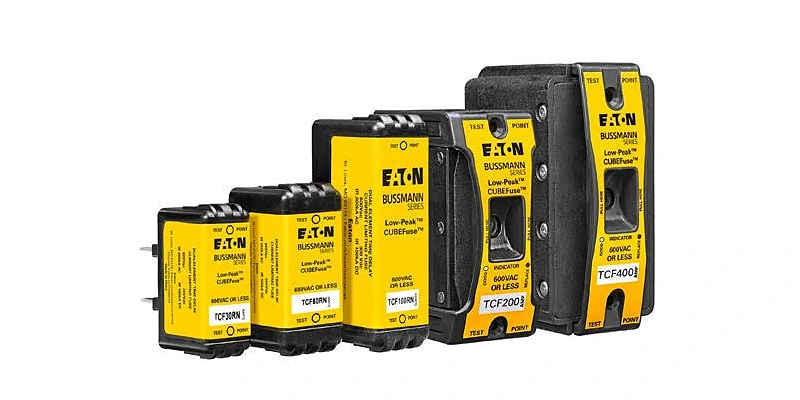
The Class CF CUBEFuse (UL 248-8 Class CF, also called Class J performance) and the Class J fuse (UL 248-8) are two UL-listed fuse classes with overlapping electrical ratings but very different physical designs and use cases. The Eaton Bussmann TCF (CUBEFuse) and LPJ (Class J) series are the most commonly specified products in these classes.
This guide compares the two side-by-side, identifies the scenarios where CUBEFuse is the better choice, and clarifies the misconceptions about CF being a “new kind of Class J.”
What Class CF Actually Means
Class CF is a UL fuse class used by the CUBEFuse system. It delivers current-limiting branch-circuit protection in a compact, rejection-style package that works only with dedicated Class CF holders. It is not a Class CC ferrule fuse, and the two classes are not mechanically interchangeable.
In other words: Class CF gives you Class J-level protection in a much smaller, finger-safe package.
Side-by-Side Specification Comparison
Where Class J Still Wins
The LPJ Class J remains the right choice for higher amperages and legacy installations:
- At higher ampere ratings, Class J often offers a broader selection. Confirm the current range of the latest TCF fuse and holder catalogs before freezing the panel design.
- Existing Class J panels with screw-type fuse blocks or knife-blade fuse holders are designed for LPJ. Retrofitting to CUBEFuse requires holder replacement.
- Lower cost for general purpose industrial use, especially at higher amperages where the smaller CF form factor does not provide enough advantage to justify the price premium.
Where Class CF CUBEFuse Wins
The TCF CUBEFuse dominates in modern panel designs, especially where safety and density matter:
- Branch circuit protection in 600 V panelboards — the finger-safe design reduces arc-flash risk during fuse replacement
- OEM equipment where the smaller footprint allows higher density (more circuits per panel)
- Installations requiring NEC 240.87 arc energy reduction — CUBEFuse holders can integrate with zone-selective interlocking more easily
- Solar PV combiner boxes and DC disconnects where DC-rated variants (TCF-RN-DCC) are available
- EV charging infrastructure where finger safety is a maintenance concern
- Food and beverage / pharmaceutical plants where exposed live parts must be minimized for compliance
Finger-Safety: The Decisive Factor for Many Specs
The single biggest practical difference is IP20 finger-safe construction. A Class J fuse on an open fuse block exposes the line side of the fuse when the fuse is removed — a worker changing the fuse can accidentally contact a live terminal. The CUBEFuse holder fully shrouds the fuse at all times, including during insertion and removal.
For facilities with arc-flash programs (NFPA 70E), this difference alone often justifies specifying TCF over LPJ for new construction, even at higher per-unit cost.
Mechanical and Dimensional Differences
The two classes use different, non-interchangeable dimensions. Compare the manufacturer’s dimensional drawings for the exact ampere rating and holder; avoid applying one percentage reduction across the entire product range.
The CUBEFuse holder is also designed for DIN-rail mounting in many configurations, simplifying panel layout. Class J fuse blocks typically require panel-mount or direct screw attachment.
Selective Coordination: Are They the Same?
LPJ and TCF products may both provide time-delay, current-limiting performance, but their curves are not interchangeable. A coordination study must use the exact catalog numbers and the manufacturer’s published time-current and let-through data.
For new designs, use the manufacturer’s published curves directly. Mixing LPJ upstream with TCF downstream is acceptable as long as the curves demonstrate selective coordination.
Practical Selection Logic
Use this decision tree:
“ Is the fuse block or holder already Class CF? ├─ Yes → Use TCF (no choice, they fit only in CF holders) └─ No → Is the panel new construction? ├─ Yes → Is ampere rating ≤ 100 A and finger-safety desired? │ ├─ Yes → Specify TCF in CUBEFuse holder │ └─ No → Specify LPJ └─ No (existing panel) → Match existing class (LPJ if Class J) “
Frequently Asked Questions
Can I use a Class CF fuse in a Class J fuse block? No. The dimensions and rejection features differ. CF fuses only fit CF holders.
Does Class CF have the same interrupting rating as Class J? Both are rated at minimum 200 kA RMS symmetrical. Bussmann rates both LPJ and TCF at 300 kA.
Is CUBEFuse more expensive than Class J? Yes, typically 20–40% higher per ampere. The premium is offset by reduced holder cost, smaller panel footprint, and improved safety.
Can I get a DC-rated CUBEFuse? Yes. The TCF-RN-DCC series is rated 600 V DC and is widely used in solar PV and battery storage applications.
Where to Buy TCF and LPJ
FuseStock stocks both the Bussmann TCF CUBEFuse (1 A – 100 A standard, with TCFH up to 400 A) and the LPJ Class J series (1 A – 600 A). Both ship with full datasheets and time-current curves.