



ANL vs MIDI Fuse: Which High-Current Fuse?
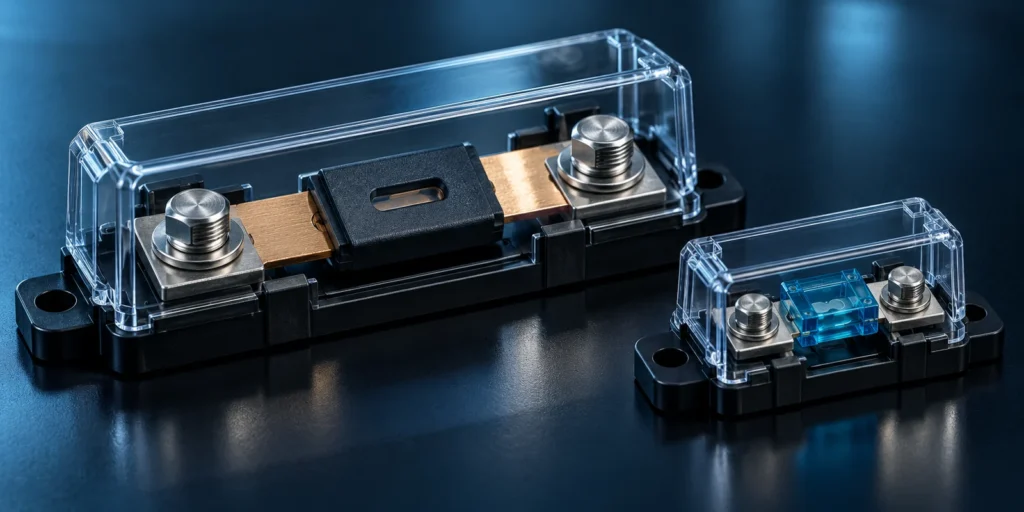
ANL vs MIDI Fuse: Which High-Current Fuse?
ANL and MIDI describe different bolt-down fuse footprints. Both appear in low-voltage power distribution, but their ampere, voltage and interrupting ratings vary by product series. One cannot be chosen solely from a rule such as “ANL above 200 A, MIDI below.”
For example, Littelfuse’s 32 V MIDI datasheet notes that 150–200 A parts are for short-circuit protection only in that series. The label “MIDI” therefore does not tell you how a particular part protects against an overload. Some newer MIDI series are rated for 70 V DC, showing why a blanket 32 V claim is unreliable.
Select the conductor and protection together. Check the smallest downstream conductor, manufacturer instructions and available fault current; then choose a documented fuse/holder combination. ANL is not automatically the highest interrupt-capacity choice, and a larger ampere rating is not a remedy for a fuse that keeps opening.