
Bussmann TCF CUBEFuse Guide: Finger-Safe Protection and Applications
Bussmann TCF CUBEFuse Guide: Finger-Safe Protection and Applications
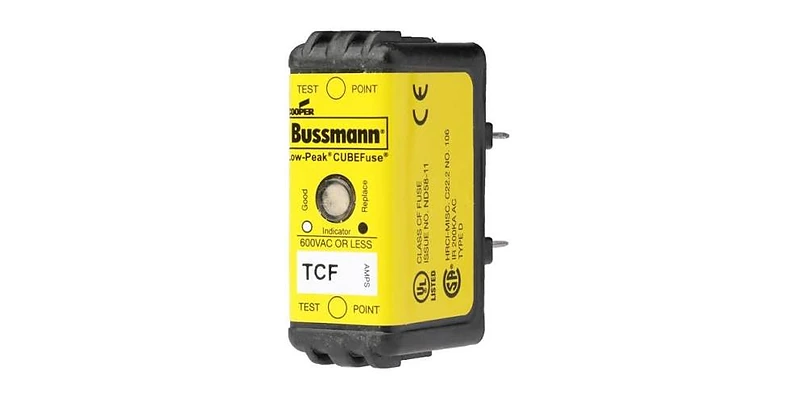
Eaton Bussmann’s CUBEFuse is a UL Class CF fuse system that combines current-limiting protection with a compact, finger-safe holder architecture. It addresses two practical panel-design needs: reducing access to live parts and fitting branch-circuit protection into modular control assemblies.
This article explains the technology behind the CUBEFuse, why it matters, and where it has become the de facto standard for new industrial installations.
The Problem CUBEFuse Solved
Before CUBEFuse, industrial fuses had two fundamental weaknesses:
1. Exposed live parts during fuse replacement. A Class J fuse on an open fuse block has live line-side terminals when the fuse is removed. Replacing the fuse requires either:
- De-energizing the entire panel (costly downtime)
- Wearing full arc-flash PPE and working carefully with insulated tools (expensive and slow)
A CUBEFuse in its dedicated holder is designed to keep live parts shrouded during normal operation and fuse handling. Fuse replacement should still follow the facility’s lockout/tagout procedure and applicable electrical-safety rules; finger-safe construction is not permission to work energized.
2. Inability to use modular DIN-rail wiring practices. Class J fuse blocks are typically panel-mounted with screw terminals. Modern industrial controls use DIN-rail-mounted terminal blocks with push-in or spring-clamp connections. The two systems don’t mix — a panel with Class J fuses has a fundamentally different layout than a panel with modern terminal blocks.
CUBEFuse holders are DIN-rail mountable, accept the same wire management accessories as terminal blocks, and integrate with the modern industrial wiring paradigm.
How CUBEFuse Works
The CUBEFuse system consists of three components:
1. The fuse itself (TCF series)
- Compact rejection-style Class CF body for use only with the specified CUBEFuse holder
- Internal element: dual-element time-delay, similar to LPJ construction
- Visual blown-fuse indicator (neon lamp on TCF-RN variants)
- Ratings: 1 A through 100 A (TCF); 1 A through 400 A (TCFH)
2. The CUBEFuse holder (TCFH holder series)
- DIN-rail mountable (35 mm rail)
- IP20 finger-safe design (no exposed live parts at any time)
- UL 4248 recognized
- Accepts TCFI (neutral) and TCFH (high-amperage) fuses
- Optional blown-fuse indicator microswitch for remote monitoring
3. The CUBEFuse power distribution block (TB100-DB or PDB series)
- Three-pole or single-pole configurations
- Accepts CUBEFuse holders on the load side
- Provides branch circuit distribution with finger-safe operation
CUBEFuse Specifications
The CUBEFuse shares the same ferrule dimensions as a Class CC fuse, but the rejection feature prevents accidental insertion of a Class CC fuse into a CUBEFuse holder.
The Visual Blown-Fuse Indicator
The TCF-RN variant includes a neon indicator light that illuminates when the fuse element melts. The indicator:
- Glows neon orange when the fuse has blown
- Is visible from the front of the holder through a transparent window
- Operates on the line-side voltage (no auxiliary power required)
- Has a typical life of 10,000 hours (neon lamp limited)
For remote monitoring, the holder can include a microswitch that closes when the fuse blows, providing a contact closure for alarm circuits or PLC inputs.
Why “Class J Performance” Matters
The UL 248-8 Class J standard defines specific electrical requirements: 600 V AC, 200 kA minimum AIC, specific time-current characteristics. A Class CF (CUBEFuse) must meet the same electrical requirements as a Class J fuse.
This means CUBEFuse can directly substitute for Class J fuses in any application — with the additional benefit of finger-safe operation. From an electrical design perspective, the two are equivalent. From an installation and maintenance perspective, CUBEFuse is significantly safer.
Where CUBEFuse Has Become the Standard
Industrial Control Panels (UL 508A)
UL 508A Industrial Control Panel standard now strongly encourages finger-safe construction. CUBEFuse holders are commonly used in:
- Motor control centers (MCCs)
- Process control panels
- Pumping station controls
- HVAC control panels
For OEMs building UL 508A panels, CUBEFuse reduces the panel’s overall footprint (smaller fuse holders) and improves the panel’s compliance with modern safety standards.
Branch Circuit Distribution in Panelboards
Several panelboard manufacturers (Square D, Eaton, Siemens) now offer CUBEFuse-compatible interior kits for their 600 V panelboards. These allow:
- Field-replacement of fuse holders without de-energizing the panel
- Per-circuit finger-safe isolation
- Smaller footprint than traditional Class J fuse blocks
EV Charging Stations
EV charging stations require frequent maintenance access (cable inspection, connector cleaning, firmware updates). CUBEFuse holders allow safe replacement of branch circuit fuses without opening the high-voltage DC compartment.
Many DC fast charger manufacturers have standardized on CUBEFuse for branch circuit protection.
Solar PV Systems
CUBEFuse holders are increasingly specified for PV combiner boxes. The DC voltage rating (300 V DC for TCF) covers 600 V PV string voltages in many installations. For higher DC voltages (1000 V or 1500 V), the FWJ semiconductor fuses are used instead.
Food and Beverage / Pharmaceutical
Hygiene-sensitive industries (food, beverage, pharmaceutical) have strict requirements to minimize exposed electrical parts. CUBEFuse holders meet these requirements while providing standard overcurrent protection.
Arc-Flash Mitigation Benefits
The single biggest practical benefit of CUBEFuse is arc-flash risk reduction during fuse replacement.
Per NFPA 70E, replacing a fuse on an energized panel typically requires:
- Arc-flash PPE rated for the available incident energy
- Insulated tools
- A written work permit
- A second person as safety watcher
With CUBEFuse:
- The fuse is replaced with the holder, not the panel — the line side is never exposed
- PPE requirements are reduced (or eliminated for the fuse replacement itself)
- No energized work permit is required
- The task can be performed by one technician
For facilities with formal arc-flash programs, the reduction in PPE and procedural overhead alone justifies the CUBEFuse premium.
CUBEFuse vs. Molded Case Circuit Breakers (MCCB)
Many applications historically specified MCCBs for branch circuit protection. CUBEFuse offers several advantages:
The trade-off is that MCCBs can be reset without a replacement part, while a blown fuse must be replaced. For applications where nuisance trips are rare and rapid recovery is not critical, CUBEFuse is usually the better choice.
The 100 A and 400 A Limitations
CUBEFuse is currently limited to 100 A (TCF) and 400 A (TCFH). For higher currents (200 A to 600 A), Class J LPJ fuses are still required. This means many facilities use a hybrid:
- Up to 100 A: CUBEFuse (TCF) in finger-safe holders
- 100 A to 400 A: TCFH CUBEFuse holders
- 400 A to 600 A: Class J (LPJ) on traditional fuse blocks or in safety switches
- Above 600 A: Class L fuses
For new construction, this hybrid is straightforward to design. For retrofit applications, replacing existing Class J fuse blocks with CUBEFuse holders requires DIN rail installation and rewiring — usually a worthwhile upgrade but not trivial.
Practical Application: 600 V Panelboard
A modern 600 V panelboard with CUBEFuse might be configured as:
“ Main: 800 A Class L breaker or fuse ↓ Busbar ↓ Branch 1: 100 A CUBEFuse holder → 75 A TCF-RN → 75 hp VFD Branch 2: 60 A CUBEFuse holder → 50 A TCF-RN → 50 hp VFD Branch 3: 30 A CUBEFuse holder → 30 A TCF-RN → lighting panel Branch 4: 100 A CUBEFuse holder → 100 A TCF-RN → HVAC unit ...42 more branches (1200 A total capacity) “
The entire panel can be built with finger-safe components, including the branch circuit fuses. Maintenance work on individual circuits can be performed without exposing any live parts.
OEM Equipment Design
Original Equipment Manufacturers (OEMs) building industrial equipment have particularly strong incentives to use CUBEFuse:
Reduced documentation: UL 508A panels with finger-safe construction require less safety labeling and documentation.
Faster certification: CUBEFuse holders are UL 4248 recognized, simplifying the panel certification process.
Smaller panels: CUBEFuse holders are roughly 30% smaller than equivalent Class J fuse blocks, allowing smaller enclosures.
Customer satisfaction: End users prefer finger-safe panels for ease of maintenance.
For OEMs exporting to Europe (where IEC 60204-1 requires finger-safe construction for many industrial machine applications), CUBEFuse meets the IP20 requirement directly.
Frequently Asked Questions
Is CUBEFuse the same as Class CC? No. Both have the same ferrule dimensions (13/32″ × 1-1/2″), but Class CC and Class CF have different electrical ratings. Class CC is rated 600 V AC, 200 kA AIC. Class CF is rated 600 V AC, 300 kA AIC with Class J time-current characteristics.
Can I replace a Class CC fuse with a CUBEFuse? Only if the holder is a CUBEFuse holder. Class CC fuses fit in Class CC holders; CUBEFuse fits in CUBEFuse holders. The rejection features prevent accidental interchange.
What is the difference between TCF and TCF-RN? TCF is the standard fuse with no indicator. TCF-RN includes a neon blown-fuse indicator that illuminates when the element melts.
Are CUBEFuse holders DIN-rail mountable? Yes. All CUBEFuse holders in the TCFH series mount on standard 35 mm DIN rail.
Can I use CUBEFuse in a 1000 V DC application? The standard TCF is rated 300 V DC. For 1000 V DC, use Bussmann FWJ series semiconductor fuses (which have ferrule mounting but a different holder).
Where to Buy CUBEFuse
FuseStock stocks the complete Bussmann CUBEFuse line — TCF fuses (1-100 A), TCFH fuses (1-400 A), CUBEFuse holders, power distribution blocks, and accessories. All products ship with full UL 248-8 / IEC 60269-4 certification documentation.
For OEM panel builders, we offer volume pricing and engineering support for CUBEFuse system design.