
Class J Fuse Complete Guide: Specifications, Applications, and LPJ Selection
Class J Fuse Complete Guide: Specifications, Applications, and LPJ Selection
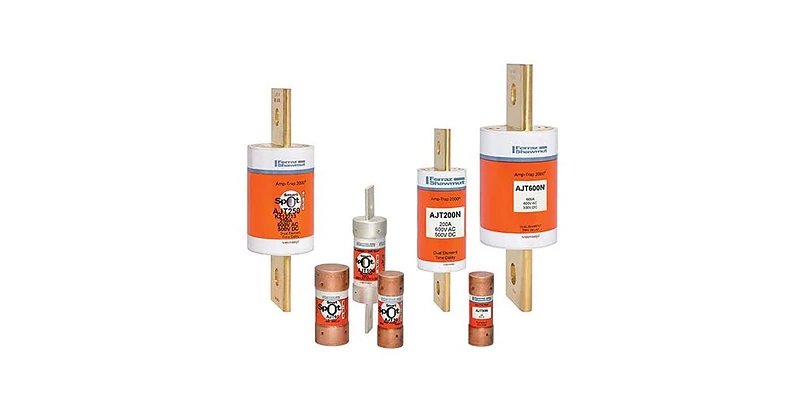
The Class J fuse is one of the most widely specified fuse classes in North American industrial electrical systems. Defined under UL 248-8, Class J fuses combine high interrupting capacity (up to 300 kA RMS symmetrical), compact dimensions, and current-limiting performance that makes them ideal for branch circuit protection, motor circuits, and feeder protection. The Eaton Bussmann LPJ series is the benchmark Class J product line, covering 1 A through 600 A in both indicating (SPI) and non-indicating (SP) configurations.
This guide walks through every specification you need to evaluate a Class J fuse, the application scenarios where Class J outperforms competing classes, and the practical selection logic used by panel builders and design engineers.
What Defines a Class J Fuse
A fuse belongs to Class J when it meets three defining requirements from UL 248-8 / CSA C22.2 No. 248.8:
- Voltage rating: 600 V AC maximum (some DC-rated variants extend to 300 V DC or 500 V DC)
- Interrupting rating: 200 kA RMS symmetrical minimum at 600 V AC; the LPJ series is rated 300 kA
- Dimensions: Single physical footprint per ampere range, with non-interchangeability with other UL classes (H, K, RK1, RK5, T, L, G, CC, CD, JF)
The non-interchangeability is a critical safety feature. Class J fuse dimensions differ from Class RK1 and RK5 dimensions at the same amperage, preventing accidental substitution of a lower-performance fuse where a current-limiting Class J is required.
LPJ Series Specifications
The Bussmann LPJ family breaks into two visual variants:
Both versions share identical dimensions for a given amperage, so the same fuse block or holder accepts either. The decision between SPI and SP comes down to whether a maintenance technician needs to identify a blown fuse without removing it.
Where Class J Fuses Are Used
Class J fuses cover a broad range of industrial applications:
- Branch circuit protection for lighting, HVAC, and receptacle loads in industrial facilities
- Motor circuit protection when paired with an IEC or NEMA motor starter
- Feeder protection in switchboards and panelboards
- Transformer protection for control transformers up to 600 V primary
- Welding equipment protection where high inrush is expected
- Power conversion equipment input protection
In data center environments, Class J fuses are increasingly specified for PDU input and feeder protection because the 300 kA interrupting rating covers the available fault current at larger transformer sizes.
How to Select an LPJ Fuse
Use this four-step process for any Class J selection:
Step 1 — Determine full-load current. Either measure with a clamp meter or compute from the load nameplate. Add 25% margin for continuous loads (per NEC 210.20(A) and 215.3), unless the fuse manufacturer’s published time-current curve shows the fuse will hold 100% continuously without nuisance tripping.
Step 2 — Verify voltage. The system voltage (line-to-line for three-phase, line-to-neutral for single-phase) must not exceed the fuse rating. For DC systems, check both polarity handling and DC voltage rating explicitly — most AC fuses do not have a DC rating.
Step 3 — Check interrupting rating. The available bolted fault current at the line-side terminals must not exceed the selected fuse’s published interrupting rating. Use a short-circuit study and verify the exact catalog number rather than assuming one product-family value fits every installation.
Step 4 — Choose indicating vs. non-indicating. Choose SPI when a blown fuse must be quickly visible from the panel front. Choose SP for enclosed disconnects or where space constraints exist.
Class J vs. Class RK1: Common Confusion
Class RK1 fuses (such as Bussmann LPS-RK and LPN-RK) have similar voltage and interrupting ratings to Class J but use a rejection feature that allows them to fit in fuse holders designed for Class H. Class J has its own dedicated rejection feature.
The functional differences are:
- Dimensions: RK1 dimensions match Class H; Class J has a different footprint and is generally smaller per ampere
- Current limitation: Class J typically provides better current-limiting performance
- Cost: RK1 is usually cheaper per fuse
If your panel is already built for Class RK1, do not substitute Class J — the dimensions differ. If you are designing a new panel, Class J is generally the better choice for new construction in commercial and industrial facilities.
Installation and Replacement Notes
Class J fuses mount in standard fuse blocks (such as the Bussmann JM60xxx series) or in safety switches sized for Class J. Always verify that the fuse block or switch is rated for Class J before installing LPJ fuses — substituting a Class H fuse block can physically accept an RK1 fuse (and vice versa) due to the rejection features but will not accept Class J.
When replacing a blown LPJ fuse, always use the exact same amperage. Up-sizing is a code violation and may damage downstream equipment. Down-sizing may cause nuisance tripping on motor starting or transformer inrush.
When to Specify LPJ Over Alternatives
Specify LPJ when:
- The application requires UL 248-8 Class J compliance
- Available fault current exceeds 100 kA (LPJ handles up to 300 kA)
- The panel design has Class J fuse blocks or switches already
- The circuit is critical enough to need a visible blown-fuse indicator (SPI variant)
- DC rating up to 300 V DC is needed for a hybrid AC/DC system
Consider alternatives (Class CC, Class RK1, Class T) when:
- The available fault current is below 200 kA and the lower cost of RK1 makes sense
- The panel uses 1-1/2 inch × 13/32 inch ferrule fuses (Class CC) instead of blade fuses
- The disconnect switch has Class T fuse clips (common in very high current DC battery systems)
Frequently Asked Questions
Can I replace a Class RK1 fuse with a Class J fuse? No. The dimensions differ and the rejection features prevent physical interchange. If the panel is RK1, it must stay RK1.
What is the difference between LPJ and JJS? JJS is the older generic UL Class J designation. LPJ is the Bussmann series — same electrical performance, modern dual-element time-delay construction.
Are LPJ fuses fast-acting or time-delay? LPJ uses dual-element time-delay construction, allowing them to handle motor inrush and transformer energization without nuisance tripping while still providing fast current limitation on short circuits.
Can LPJ fuses be used in DC circuits? Yes, with limits. LPJ is rated 300 V DC for fuses 1 A through 60 A, and 200 V DC for 70 A through 600 A. For higher DC voltages, specify a DC-rated fuse class (typically DC-rated midget or DC-rated Class J).
Where to Buy LPJ-SPI and LPJ-SP Fuses
FuseStock stocks the complete Bussmann LPJ series from 1 A to 600 A, both SPI (indicating) and SP (non-indicating) variants. All LPJ fuses ship with full datasheet and time-current curve documentation. Submit a quote request on the product page for current pricing and lead time.