



What Size Fuse for an Amplifier?
What Size Fuse for an Amplifier?
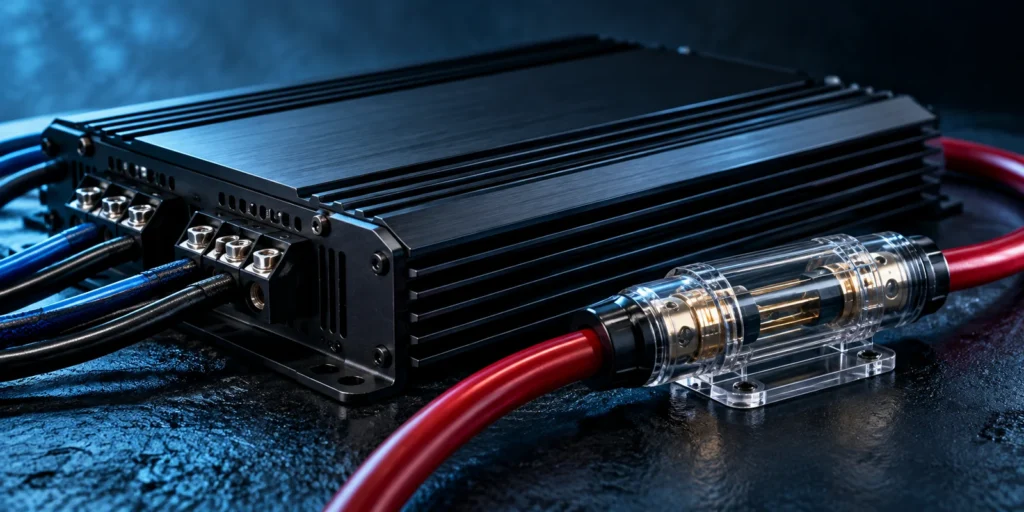
An amplifier installation usually has a battery-side fuse on the new power cable and may also have fuses inside the amplifier. The battery-side device protects the cable between battery and amplifier.
Work from real specifications
- Find the amp’s continuous RMS rating, efficiency or input-current specification, onboard fuse rating and installation instructions. Do not use “peak” speaker power as a DC-current specification.
- Estimate draw if necessary:
DC input A ≈ RMS output W ÷ (DC voltage × efficiency). For example, 500 W at 13.8 V and 85% efficiency is about 43 A; at lower voltage, draw may rise. - Size copper cable for its run, temperature, insulation, routing and voltage drop. Verify the power and ground connections and the smallest section.
- Choose the recommended DC fuse and holder near the supply, no higher than the protected conductor’s installation-specific ampacity. Check the fuse’s voltage and interrupt ratings.
Multiple amplifiers or a stepped-down distribution block may need branch protection. A fixed chart pairing 8, 4 or 2 AWG with a single “maximum fuse” is unreliable without installation details. A fuse opening under use calls for diagnosis of the supply, amp and speaker load.